Transformer Encoder with Mixed (Legendre + B-Spline) embeddings#
Here we demonstrate we can use curves as input embeddings to a Transformer model that learns from tabular data. The categorical features are treated as regular tokens having embedding vectors. Numerical feature embeddings are points on curves defined by B-Splines and Legendre polynomials. We also show that it might be reasonable to use B-Splines do define features of “spatial” nature, such as latitude and longitude, whereas use Legendre curves for features of “spectral” nature - there is some overall trend of the target variable behavior as a function of the feature that can be captured by the lower frequency components.
[2]:
import math
from typing import Sequence

import kagglehub as kh
import matplotlib.pyplot as plt
import numpy as np
import torch
import torch.utils.data as td
from sklearn.compose import make_column_transformer
from sklearn.ensemble import HistGradientBoostingRegressor
from sklearn.impute import SimpleImputer
from sklearn.linear_model import LinearRegression
from sklearn.metrics import root_mean_squared_error
from sklearn.pipeline import make_pipeline
from sklearn.preprocessing import MinMaxScaler, OneHotEncoder, OrdinalEncoder, StandardScaler
from torch import nn

import torchcurves as tc
Prepare data#
[3]:
file_path = "housing.csv"
df = kh.dataset_load(
    kh.KaggleDatasetAdapter.PANDAS,
    "camnugent/california-housing-prices",
    file_path
)
Warning: Looks like you're using an outdated `kagglehub` version (installed: 0.3.12), please consider upgrading to the latest version (1.0.0).
[4]:
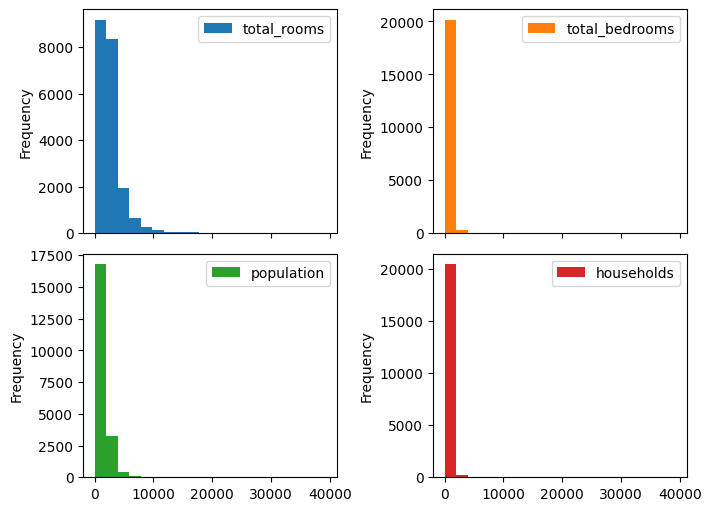
# columns that we know have a very skewed distribution
skewed_columns = ['total_rooms', 'total_bedrooms', 'population', 'households']
df[skewed_columns].plot.hist(
    bins=20, subplots=True, layout=(2, 2), figsize=(7, 5)
)
plt.gcf().set_layout_engine('constrained')
[5]:
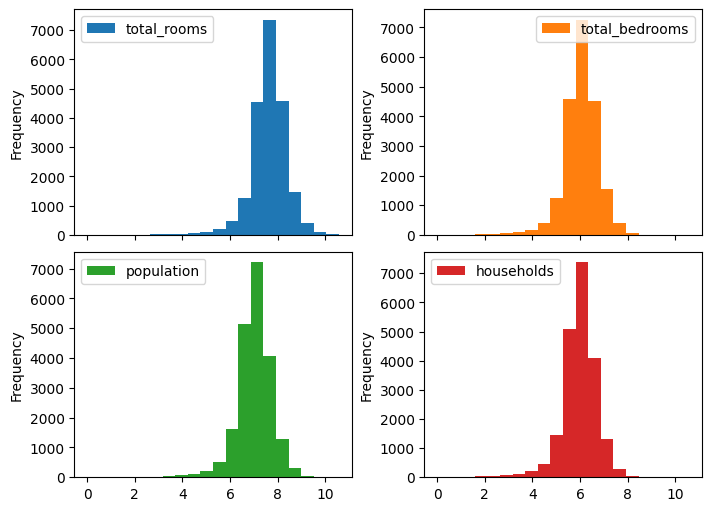
# apply log transformation and plot histograms
df.loc[:, skewed_columns] = df[skewed_columns].apply(np.log)
df[skewed_columns].plot.hist(
    bins=20, subplots=True, layout=(2, 2), figsize=(7, 5)
)
plt.gcf().set_layout_engine('constrained')
[6]:
spectral_cols = ['total_rooms', 'total_bedrooms', 'population', 'households', 'median_income']
spatial_cols = ['longitude', 'latitude', 'housing_median_age']
numerical_cols = spectral_cols + spatial_cols
cat_cols = ['ocean_proximity']
label_col = 'median_house_value'
[7]:
train_df = df.sample(frac=0.8, random_state=2025)
test_df = df.drop(train_df.index)
Preprocess data#
[8]:
X_train, y_train = train_df.drop(label_col, axis=1), train_df[[label_col]]
X_test, y_test = test_df.drop(label_col, axis=1), test_df[[label_col]]
[9]:
feat_preprocessor = make_column_transformer(
    (OrdinalEncoder(), cat_cols), # categorical: ordinal encode
    (make_pipeline(
        SimpleImputer(),
        StandardScaler()
    ), spectral_cols),            # spectral: impute then standardize
    (make_pipeline(
        SimpleImputer(),
        MinMaxScaler(feature_range=(-1, 1), clip=True)
    ), spatial_cols),            # spatial: impute then minmax-scale
    verbose_feature_names_out=False
).set_output(transform='pandas')
label_preprocessor = StandardScaler()
[10]:
X_train_pp = feat_preprocessor.fit_transform(X_train)
X_test_pp = feat_preprocessor.transform(X_test)

y_train_pp = label_preprocessor.fit_transform(y_train)
y_test_pp = label_preprocessor.transform(y_test)
[11]:
X_train_pp[cat_cols] = X_train_pp[cat_cols].astype(np.int32)
X_train_pp[numerical_cols] = X_train_pp[numerical_cols].astype(np.float32)
X_test_pp[cat_cols] = X_test_pp[cat_cols].astype(np.int32)
X_test_pp[numerical_cols] = X_test_pp[numerical_cols].astype(np.float32)

col_sets = [spectral_cols, spatial_cols, cat_cols]
X_train_tensors = tuple(torch.as_tensor(X_train_pp[cols].values) for cols in col_sets)
X_test_tensors = tuple(torch.as_tensor(X_test_pp[cols].values) for cols in col_sets)
[12]:
num_cat_features = [
    len(cats) for cats in feat_preprocessor['ordinalencoder'].categories_
]
[13]:
len(X_train)
[13]:
16512
Evaluate baselines#
[14]:
baseline_model = make_pipeline(
    make_column_transformer(
        (OneHotEncoder(), cat_cols),
        remainder='passthrough'
    ),
    HistGradientBoostingRegressor(loss='squared_error')
)
baseline_model.fit(X_train, y_train.values.ravel())
pred = baseline_model.predict(X_test)
baseline_rmse = root_mean_squared_error(y_test, pred)
print(f'Baseline RMSE = {baseline_rmse}')
Baseline RMSE = 46763.53109042211
[15]:
baseline_model = make_pipeline(
    make_column_transformer(
        (OneHotEncoder(), cat_cols),  # categorical: one-hot encode
        (make_pipeline(
            SimpleImputer(),
            StandardScaler(),
        ), spectral_cols),            # spectral: impute then standardize
        (make_pipeline(
            SimpleImputer(),
            MinMaxScaler(feature_range=(-1, 1), clip=True)
        ), spatial_cols),            # spatial: impute then minmax-scale
    ),
    LinearRegression()
)
baseline_model.fit(X_train, y_train.values.ravel())
pred = baseline_model.predict(X_test)
baseline_rmse = root_mean_squared_error(y_test, pred)
print(f'Baseline RMSE = {baseline_rmse}')
Baseline RMSE = 65307.28156452821
Train and evaluate transformers#
Define modules#
[16]:
class EmbeddingLayer(nn.Module):
    def __init__(self, n_spectral: int, n_spatial: int, n_cat: Sequence[int], emb_dim: int, n_coef: int = 10,
                 dropout_p=0.1):
        super().__init__()

        # offset for the categorical feature of each column
        offsets = [sum(n_cat[:i]) for i in range(len(n_cat))]
        self.register_buffer("offsets", torch.tensor(offsets))

        # embeddings for each type of feature
        self.spectral_emb = tc.LegendreCurve(n_spectral, emb_dim, degree=n_coef - 1, input_map='real.rational')
        self.spatial_emb = tc.BSplineCurve(n_spatial, emb_dim, knots_config=n_coef, input_map='real.clamp')
        self.cat_emb = nn.Embedding(sum(n_cat), emb_dim)

        # post-processing for the embeddings, before feeding them into the transformer
        self.postprocess = nn.Sequential(nn.LayerNorm(emb_dim), nn.Dropout(dropout_p))

    def forward(self, x_spectral, x_spatial, x_cat):
        spectral_emb = self.spectral_emb(x_spectral)
        spatial_emb = self.spatial_emb(x_spatial)
        cat_emb = self.cat_emb(x_cat + self.offsets.to(x_cat.dtype).unsqueeze(0))
        emb = torch.concatenate((spectral_emb, spatial_emb, cat_emb), dim=-2)
        return self.postprocess(emb)

    @staticmethod
    def get_offsets(n_cat: Sequence[int]):
        sum = 0
        yield sum
        for n in n_cat:
            sum += n
[17]:
class SinusoidalPositionalEncoding(nn.Module):
    def __init__(self, emb_dim, max_len=16, base=16.0):
        super().__init__()
        h = emb_dim // 2
        pos = torch.arange(max_len)[:, None]
        div = base ** (2 * torch.arange(h) / emb_dim)
        ang = pos / div
        pe = torch.empty(max_len, emb_dim)
        pe[:, 0::2] = ang.sin()
        pe[:, 1::2] = ang.cos()
        self.register_buffer('pe', pe)

    def forward(self, x):
        return x + self.pe[:x.size(1)].unsqueeze(0).type_as(x)
[18]:
class TransformerModel(nn.Module):
    def __init__(self,
                 n_spectral: int, n_spatial: int, n_cat: Sequence[int], emb_dim: int, n_coef: int = 10,
                 num_heads: int = 4, num_layers: int = 4, dim_feedforward: int | None = None):
        dim_feedforward = dim_feedforward if dim_feedforward is not None else 4 * emb_dim
        super().__init__()
        self.embeddings = EmbeddingLayer(n_spectral, n_spatial, n_cat, emb_dim, n_coef)
        self.pe = SinusoidalPositionalEncoding(emb_dim, max_len=n_spectral + n_spatial + len(n_cat))
        self.transformer = nn.TransformerEncoder(
            encoder_layer=nn.TransformerEncoderLayer(
                emb_dim, num_heads, batch_first=True, dim_feedforward=dim_feedforward
            ),
            num_layers=num_layers
        )
        self.fc = nn.Linear(emb_dim, 1)

    def forward(self, tensors: Sequence[torch.Tensor]):
        emb = self.embeddings(*tensors)
        pos_emb = self.pe(emb)
        encoded = self.transformer(pos_emb)
        pooled = torch.mean(encoded, axis=-2)
        return self.fc(pooled)
Define config#
[19]:
# architecture
n_curve_coefs = 16
num_layers = 4
emb_dim = 32
num_heads = 4

# training loop params
num_epochs = 100
print_every = 10
batch_size = 32

# optimizer params - common heuristics for transformers
optimizer_params = {
    "lr": 0.001,
    "weight_decay": 0.1,
    "betas": (0.9, 0.95),
}

# sizes
num_features = X_train_pp.shape[1]
train_set_size = len(X_train_pp)
test_set_size = len(X_test_pp)
[20]:
device = "cuda" if torch.cuda.is_available() else "cpu"
/home/alex/git/torchcurves/.venv/lib/python3.12/site-packages/torch/cuda/__init__.py:174: UserWarning: CUDA initialization: The NVIDIA driver on your system is too old (found version 11040). Please update your GPU driver by downloading and installing a new version from the URL: http://www.nvidia.com/Download/index.aspx Alternatively, go to: https://pytorch.org to install a PyTorch version that has been compiled with your version of the CUDA driver. (Triggered internally at /pytorch/c10/cuda/CUDAFunctions.cpp:109.)
  return torch._C._cuda_getDeviceCount() > 0
Define training loop#
[21]:
train_ds = td.TensorDataset(*X_train_tensors, torch.as_tensor(y_train_pp).float())
eval_ds = td.TensorDataset(*X_test_tensors, torch.as_tensor(y_test_pp).float())
[22]:
def train_epoch(model, optim, lr_scheduler, criterion, train_dl):
    tr_loss = torch.tensor(0.).to(device)
    for *xb, yb in train_dl:
        pred = model(x.to(device) for x in xb)
        loss = criterion(yb.to(device), pred)

        optim.zero_grad()
        loss.backward()
        optim.step()
        lr_scheduler.step()

        with torch.no_grad():
            tr_loss += loss * torch.numel(yb)
    return tr_loss.item() / train_set_size


@torch.no_grad
def eval_epoch(model, eval_criterion, eval_dl):
    eval_total_error = 0.
    for *xb, yb in eval_dl:
        # predict
        pred = model(x.to(device) for x in xb)

        # compute label and prediction in terms of the original, unscaled labels
        label_orig = label_preprocessor.inverse_transform(yb.view(-1, 1))
        pred_orig = label_preprocessor.inverse_transform(pred.cpu().view(-1, 1))

        # compute loss on the original labels
        loss = eval_criterion(
            torch.as_tensor(label_orig, device=device, dtype=torch.float32),
            torch.as_tensor(pred_orig, device=device, dtype=torch.float32)
        )
        eval_total_error += loss * torch.numel(yb)
    return eval_total_error.item() / test_set_size
[23]:
def get_linear_scheduler(optimizer, warmup_steps, total_steps):
    def lr_lambda(current_step):
        if current_step < warmup_steps:
            return float(current_step) / float(max(1, warmup_steps))
        progress = float(current_step - warmup_steps) / float(max(1, total_steps - warmup_steps))
        return max(0., 1.0 - progress)

    return torch.optim.lr_scheduler.LambdaLR(optimizer, lr_lambda, last_epoch=-1)
[24]:
def train_eval_model(name, model: nn.Module, batch_size: int, print_progress=True, **optim_kwargs):
    model = model.to(device)
    optim = torch.optim.AdamW(model.parameters(), **optim_kwargs)
    criterion = nn.MSELoss()
    train_dl = td.DataLoader(train_ds, batch_size=batch_size, shuffle=True)
    eval_dl = td.DataLoader(eval_ds, batch_size=128)

    total_steps = len(train_dl) * num_epochs
    warmup_steps = int(0.1 * total_steps)
    scheduler = get_linear_scheduler(optim, warmup_steps, total_steps)

    for epoch in range(1, num_epochs + 1):
        train_loss = train_epoch(model, optim, scheduler, criterion, train_dl)

        if print_progress and (epoch % print_every == 0 or epoch == num_epochs):
            model.eval()
            eval_loss = eval_epoch(model, criterion, eval_dl)
            eval_rmse = math.sqrt(eval_loss)
            model.train()

            print(f'[{name}] Epoch {epoch}, tr loss = {train_loss:.4f}, eval RMSE = {eval_rmse:.2f}')

    return model
Run experiments#
[25]:
model = train_eval_model(
    "Transformer",
    TransformerModel(
        len(spectral_cols), len(spatial_cols), num_cat_features,
        emb_dim=emb_dim,
        num_heads=num_heads,
        num_layers=num_layers,
        n_coef=n_curve_coefs,
    ),
    batch_size=batch_size,
    **optimizer_params,
)
[Transformer] Epoch 10, tr loss = 0.2086, eval RMSE = 53314.85
[Transformer] Epoch 20, tr loss = 0.1865, eval RMSE = 48611.22
[Transformer] Epoch 30, tr loss = 0.1748, eval RMSE = 47873.05
[Transformer] Epoch 40, tr loss = 0.1702, eval RMSE = 47460.96
[Transformer] Epoch 50, tr loss = 0.1654, eval RMSE = 47742.28
[Transformer] Epoch 60, tr loss = 0.1596, eval RMSE = 46844.31
[Transformer] Epoch 70, tr loss = 0.1538, eval RMSE = 47298.07
[Transformer] Epoch 80, tr loss = 0.1450, eval RMSE = 46950.22
[Transformer] Epoch 90, tr loss = 0.1366, eval RMSE = 47268.73
[Transformer] Epoch 100, tr loss = 0.1311, eval RMSE = 47060.50
[ ]: