Kolmogorov-Arnold Network with Legendre approximation#
We demonstrate a Kolmogorov-Arnold network whose learned activation functions are Legendre polynomials composed with the real.rational input map. This shows that KAN activations can be approximated in many different ways, and do not have to be necessarily splines.
[1]:
import matplotlib.pyplot as plt
import torch
from torch import nn

import torchcurves as tc
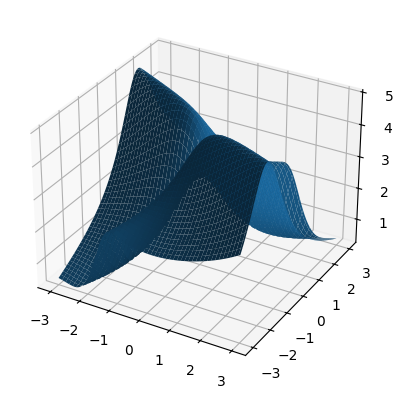
Define regression function#
[2]:
def func(xs):
    pole_1 = torch.tensor(0-2j)
    pole_2 = torch.tensor(0-1j)
    cresult = 10 / (xs[:, 0] + 2 * xs[:, 1] - pole_1) - 2 / (2 * xs[:, 0] - xs[:, 1] - pole_2)
    return cresult.abs()
[3]:
n = 100
xs = torch.linspace(-3, 3, n)
ys = torch.linspace(-3, 3, n)
grid = torch.cartesian_prod(xs, ys)
zs = func(grid)
[4]:
ax = plt.figure().add_subplot(projection='3d')
grid_x = grid[:, 0].reshape(n, n)
grid_y = grid[:, 1].reshape(n, n)
plot_z = zs.reshape(n, n)
ax.plot_surface(grid_x, grid_y, plot_z)
[4]:
<mpl_toolkits.mplot3d.art3d.Poly3DCollection at 0x74a8ed65cbf0>
Generate training data#
[5]:
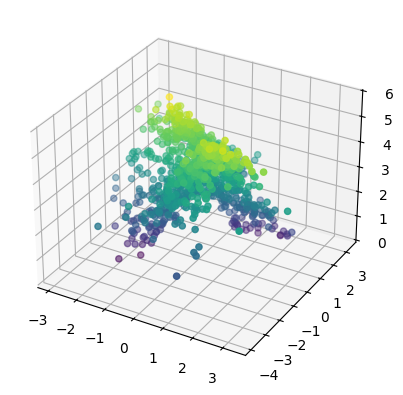
n_samples = 1000
sigma = 0.3
X = torch.randn(n_samples, 2)
y = func(X) + sigma * torch.randn(n_samples)
[6]:
ax = plt.figure().add_subplot(projection='3d')
ax.scatter3D(X[:, 0], X[:, 1], y, c=y)
[6]:
<mpl_toolkits.mplot3d.art3d.Path3DCollection at 0x74a8eaacb950>
Define and train the KAN#
[7]:
input_dim = 2
intermediate_dim = 5
degree = 5

kan = nn.Sequential(
    # layer 1
    tc.LegendreCurve(input_dim, intermediate_dim, degree=degree, input_map='real.rational'),
    tc.Sum(dim=-2),
    # layer 2
    tc.LegendreCurve(intermediate_dim, intermediate_dim, degree=degree, input_map='real.rational'),
    tc.Sum(dim=-2),
    # layer 3
    tc.LegendreCurve(intermediate_dim, 1, degree=degree, input_map='real.rational'),
    tc.Sum(dim=-2),
)
[8]:
example_data = torch.tensor([[-5, 3], [3, 2], [1, 3]])
output = kan(example_data)
print(output.shape)
torch.Size([3, 1])
[9]:
n_epochs = 100
batch_size = 32
lr = 2e-3
print_every = 10

dl = torch.utils.data.DataLoader(torch.utils.data.TensorDataset(X, y), batch_size=batch_size, shuffle=True)
optim = torch.optim.Adam(kan.parameters(), lr=lr)
criterion = nn.MSELoss()

for epoch in range(1, 1 + n_epochs):
    epoch_loss = 0.
    for Xb, yb in dl:
        pred = kan(Xb)
        cost = criterion(pred.squeeze(), yb)

        optim.zero_grad()
        cost.backward()
        optim.step()

        epoch_loss += cost * Xb.shape[0]

    epoch_loss /= n_samples
    eval_loss = criterion(kan(grid).squeeze(), func(grid))

    if epoch == n_epochs or epoch % print_every == 0:
        print(f'Epoch {epoch}: train loss = {epoch_loss:.3f}, eval_loss = {eval_loss:.3f}')
/home/alex/git/torchcurves/.venv/lib/python3.12/site-packages/torch/autograd/graph.py:824: UserWarning: CUDA initialization: The NVIDIA driver on your system is too old (found version 11040). Please update your GPU driver by downloading and installing a new version from the URL: http://www.nvidia.com/Download/index.aspx Alternatively, go to: https://pytorch.org to install a PyTorch version that has been compiled with your version of the CUDA driver. (Triggered internally at /pytorch/c10/cuda/CUDAFunctions.cpp:109.)
  return Variable._execution_engine.run_backward(  # Calls into the C++ engine to run the backward pass
Epoch 10: train loss = 0.338, eval_loss = 0.477
Epoch 20: train loss = 0.135, eval_loss = 0.233
Epoch 30: train loss = 0.118, eval_loss = 0.219
Epoch 40: train loss = 0.107, eval_loss = 0.197
Epoch 50: train loss = 0.105, eval_loss = 0.196
Epoch 60: train loss = 0.102, eval_loss = 0.191
Epoch 70: train loss = 0.102, eval_loss = 0.180
Epoch 80: train loss = 0.097, eval_loss = 0.168
Epoch 90: train loss = 0.093, eval_loss = 0.184
Epoch 100: train loss = 0.092, eval_loss = 0.171
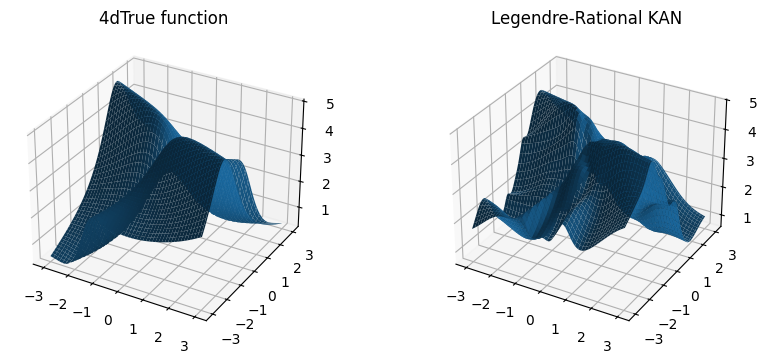
Plot the network and the true function, side by side#
[10]:
with torch.no_grad():
    kan_z = kan(grid).reshape(n, n)
fig = plt.figure(figsize=(10, 4))
ax_left = fig.add_subplot(1, 2, 1, projection='3d')
ax_right = fig.add_subplot(1, 2, 2, projection='3d')

ax_left.set_title('4dTrue function')
ax_left.plot_surface(grid_x, grid_y, plot_z)

ax_right.set_title('Legendre-Rational KAN')
ax_right.plot_surface(grid_x, grid_y, kan_z)

plt.show()
[ ]: